
An illusion that could save your life:
Why Flashing Lights Can Create the Illusion of Movement
An aspect of the science behind dynamic emergency exit signage
Most people have experienced the effect without giving it much thought. A row of roadwork warning lights appears to move in sequence. Vehicle hazard lights seem to pulse in waves. A set of LEDs appears to chase, sweep or flow, even though every light is fixed in place.
This is not simply clever electronics. It is the result of a precise interaction between light, timing and the way the human brain interprets visual information.
Understanding this phenomenon is more than a scientific curiosity. It is directly relevant to the design of dynamic emergency signage systems, where rapid recognition, instinctive direction-finding and attention capture can materially improve the way people respond during an evacuation.
Key Takeaways
Principle | Why it matters for emergency signage |
Apparent motion | Sequential flashes can be perceived as movement, helping people follow a direction rather than interpret a static instruction. |
Peripheral sensitivity | The edge of human vision is highly responsive to motion, flicker and contrast change, so dynamic signs are harder to miss. |
Reduced cognitive load | A flowing or chasing sequence gives an intuitive cue, reducing the amount of conscious reading required under stress. |
Environmental resilience | Dynamic light can remain noticeable in low visibility, smoke and visual clutter when static signs may be overlooked. |
Motion From Stillness
At its core, perceived movement in flashing lights is an illusion. The lights themselves are stationary. What changes is the order, timing, brightness and spacing of their illumination.
When these variables are coordinated correctly, separate static lights can create a convincing impression of motion. The same broad principle underpins film, television, animated signs, runway lighting, vehicle indicators, theatre lighting effects, hazard systems and modern adaptive emergency signage.
The effect becomes especially powerful when the flashing sequence aligns with the way the human visual system naturally detects motion and direction.
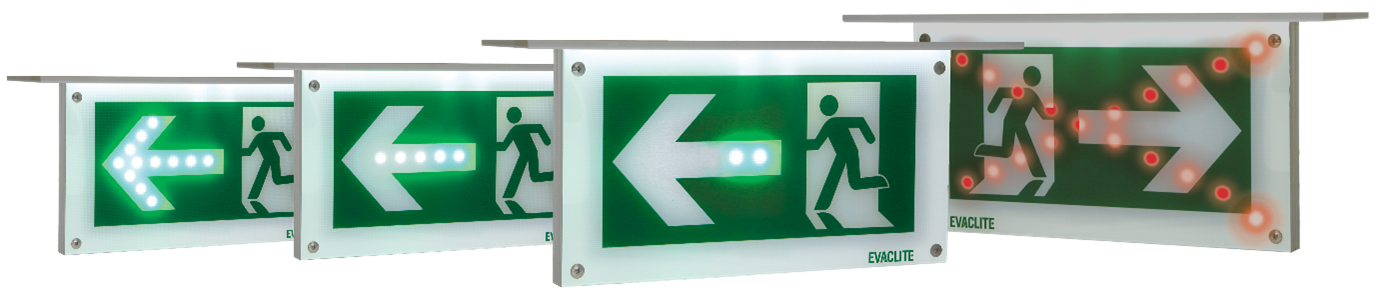
The Human Brain Is Designed to Detect Movement
Movement detection is one of the brain’s highest visual priorities. From an evolutionary perspective, noticing movement quickly could mean identifying a threat, finding a path or responding to a change in the environment.
A static object may blend into its surroundings. A moving or flickering object is far more likely to attract attention. This is particularly important in low visibility, smoke-filled environments, high-stress situations, peripheral vision, crowded spaces and areas where people may already be distracted.
Dynamic light sequences take advantage of this natural priority system. Instead of relying only on a person to consciously read a sign, the lighting itself attracts attention and suggests direction.
Persistence of Vision
One mechanism involved is often described as persistence of vision. When the eye sees an image, the visual system retains that information briefly after the light source disappears.
If a second light appears nearby during this short interval, the brain can blend the two events into a continuous experience. This is one reason a rapid sequence of still film frames appears as continuous motion.
The same principle applies to flashing LEDs. If adjacent lights illuminate at carefully controlled intervals, the brain interprets the sequence as movement rather than as isolated flashes.
The Phi Phenomenon and Apparent Motion
Psychologists studying perception identified related effects formally in the early 20th century. Two important concepts are the phi phenomenon and beta movement. Both describe how the brain can perceive motion between separate visual events, even when nothing physically travels between them.
Simple Example
Imagine three LEDs arranged in a straight line:
Stage 1: ● ○ ○
Stage 2: ○ ● ○
Stage 3: ○ ○ ●
If the sequence happens slowly, we see three separate flashes. When the timing enters the right perceptual range, the brain no longer treats them as independent lights. Instead, it perceives a single point of light moving across the line.
The movement is created inside the visual system. Nothing actually moves.
Why Synchronisation Changes Everything
Anyone who has watched roadwork warning lights may have noticed that what first seems random can suddenly appear ordered and directional. This happens because the human visual system is highly sensitive to timing relationships.
When multiple flashing sources drift into recognisable intervals, the brain begins linking them into a coherent pattern. Order appears to emerge from randomness, producing impressions such as directional flow, pulsing waves, sweeping effects or rotational movement.
The effect can be particularly noticeable at night, when background visual distractions are reduced and the contrast between light and environment increases.
The Stroboscopic Effect
The stroboscopic effect is another relevant visual phenomenon. A strobe light emits flashes at precise intervals. When those flashes interact with movement, or with other flashing sources, unusual visual effects can occur.
Objects may appear to move slowly, freeze, reverse direction, jump between positions or move in discrete steps. This happens because the eye receives intermittent snapshots of reality, and the brain reconstructs motion from incomplete information.
Rotating Object Example
Consider a rotating fan illuminated by a flashing light. If the flash frequency matches the fan’s rotation, the fan may appear stationary. If the flash rate differs slightly, the fan may appear to rotate slowly or even backwards.
This principle is used in industrial inspection, high-speed photography, entertainment lighting and machinery analysis. It can also contribute to the visual behaviour of synchronised LED systems and dynamic signage.
Why Dynamic Signage Works So Effectively
Traditional emergency signs are passive. They rely on a person seeing the sign, recognising it, reading it, interpreting it and then deciding what to do.
Under stress, that process can slow down. Dynamic signage changes the interaction. Instead of waiting to be consciously interpreted, the lighting actively attracts attention. Sequential flashing patterns naturally encourage the eye to follow direction.
For example:

or:
- ○ ○ ○
○ ● ○ ○
○ ○ ● ○
○ ○ ○ ●
The brain tends to follow the apparent motion. This can improve recognition, directional clarity, visibility in smoke or low light, attention capture and reaction speed. The result is signage that communicates more intuitively than static signs alone.
Peripheral Vision and Attention Capture
One of the strongest advantages of dynamic lighting is its effectiveness within peripheral vision. Human peripheral vision is particularly sensitive to motion, flicker, contrast change and sudden illumination.
This matters during evacuation because people are rarely standing still and calmly reading signs. They may be walking, looking for others, avoiding obstacles or trying to understand conflicting information.
A person may not be directly looking at an exit sign, but a sequenced light pattern can still attract attention from the edge of the visual field. Static signs are easier to overlook. Dynamic signs are much harder for the brain to ignore.
In the world of signage, a related concept introduced by the Fire Safety and Engineering Group (FSEG) at the University of Greenwich, is the VCA or Visibility Catchment Area. This broadly refers to a sign’s visibility when viewed from locations other than head on, so indirectly or within the periphery and is defined as the region of floor area from where it is physically possible to discern information from the sign.
Originally conceived as semi-circle based upon the maximum viewing distance of any given sign, the actual region from where a sign is visible is also dependent on the angle of observation thus making the VCA circular in shape, with a diameter equal to the maximum viewing distance instead (courtesy of FSEG)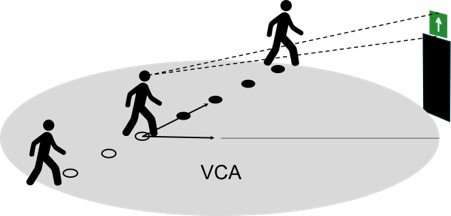
The Importance of Timing
The effectiveness of apparent motion depends heavily on timing. If the sequence is too slow, the illusion breaks down and the lights appear independent. If it is too fast, the lights may blur together and the direction becomes ambiguous.
Effective dynamic signage therefore requires careful optimisation of flash duration, duty cycle, transition timing, sequencing order, spacing between light sources, brightness, viewing distance and environmental conditions.
Small timing changes can significantly alter perception. This is where technical understanding becomes critical: a system should not merely flash; it should communicate.
Smoke, Stress and Human Behaviour
Emergency environments create unique challenges. People under stress may experience reduced concentration, narrowed attention, slower decision-making, visual overload and panic responses.
Smoke further reduces visibility by lowering contrast and obscuring static visual information. Dynamic lighting can help counteract these conditions because movement and flicker remain detectable when fine detail is reduced.
For this reason, dynamic directional systems can be especially valuable in large public buildings, entertainment venues, transport hubs, industrial facilities, hotels and healthcare environments.
Dynamic Guidance vs Traditional Signage
The difference between static and dynamic signage is similar to the difference between reading directions on paper and following a moving guide.
One requires interpretation. The other encourages instinctive following behaviour.
During an emergency evacuation, that distinction matters. Time is limited, visibility may be compromised, stress is elevated and people may not process information as calmly as they would in normal conditions. Dynamic directional lighting can reduce the amount of conscious interpretation required.
Engineering the Illusion
Creating convincing apparent movement is not simply a matter of making lights flash. Effective systems require a coordinated understanding of visual perception, neurological response, flash frequency behaviour, timing relationships, contrast sensitivity, environmental lighting, optical diffusion, viewing angles and human behaviour under stress.
In practice, successful systems are the result of both engineering and psychology. The technology works because it aligns with the way the brain naturally processes visual information.
Dynamic Emergency Signage Design
The following design principles help ensure clearer, safer and more effective dynamic signage. They have been established and validated over many years of product development and should be applied alongside the relevant local fire safety, emergency lighting and accessibility requirements.
- Start with compliance, then enhance it. Dynamic features should complement recognised emergency exit symbols and established safety colours rather than replace them.
- Keep direction unambiguous. Use sequencing that clearly leads the eye toward the safe route. Avoid effects that could be interpreted as decorative, random or bidirectional.
- Optimise timing through testing. Flash rates, transition intervals and duty cycles should be validated with real viewing distances, expected mounting heights and likely ambient lighting conditions.
- Design for smoke and low visibility. Use sufficient contrast, robust luminance and appropriate diffusion so the sign remains visible without creating glare.
- Avoid visual overload. Dynamic systems should attract attention, not create confusion. Limit competing flashing elements near exits, decision points and escape routes.
- Consider peripheral detection. Place dynamic cues where they can be detected from natural approach paths, not only from directly in front of the sign.
- Use dynamic guidance at decision points. The highest-value locations are junctions, corridors, stair approaches, changes of direction and areas where occupants must choose between routes.
- Plan for adaptive operation. Where systems can respond to fire detection, smoke detection or building management data, ensure unsafe routes can be clearly de-emphasised or blocked from guidance logic.
- Build in fail-safe behaviour. If communications, sensors or control logic fail, signage should revert to a safe, compliant default state rather than displaying misleading information.
- Include maintenance and testing. Dynamic systems require inspection of LEDs, batteries, control modules, timing behaviour, visibility, and any integration with fire or building systems.
- Test with users, not only engineers. A system that appears logical on a drawing may be misunderstood in a real evacuation context. Human-factors testing should form part of commissioning.
- Document the design intent. Record why each dynamic sequence, location and operating mode was selected so future maintenance teams can preserve the system’s safety purpose.
Specification Checklist
- Confirm applicable standards, codes and authority requirements before specifying the system.
- Map escape routes, decision points, visual obstructions and likely occupant flow.
- Identify where static signage is sufficient and where dynamic guidance adds meaningful benefit.
- Define normal, alarm, fault and power-loss operating modes.
- Validate directional sequences from realistic viewing positions and distances.
- Assess glare, contrast and visibility under normal lighting, emergency lighting and smoke conditions where practicable.
- Coordinate with fire alarm, emergency lighting, building management and evacuation strategy documentation.
- Provide commissioning records, maintenance instructions and periodic test procedures.
A Practical Application of Perceptual Science
Dynamic emergency signage is a practical example of applied perceptual science. It combines physics, electronics, timing control, optical engineering, human factors research, behavioural psychology and neurology to achieve one critical objective: helping people identify safe escape routes faster and more intuitively.
What appears to be a simple flashing sequence is actually a carefully engineered interaction between light and human perception. When designed correctly, that interaction can improve visibility, recognition and directional guidance when it matters most.
Conclusion
The apparent movement seen in flashing lights is not an accident. It is the result of well-understood perceptual principles, including persistence of vision, apparent motion, the phi phenomenon, stroboscopic interaction and human sensitivity to motion.
These effects explain why synchronised flashing lights can appear to flow, sweep and direct attention so effectively. More importantly, they explain why dynamic emergency signage can communicate direction more instinctively than static signs alone.
By working with the way the brain naturally prioritises movement and visual change, dynamic lighting systems can improve attention capture, directional guidance and response speed, particularly in stressful and visually challenging conditions where effective evacuation guidance matters most.
The science behind these systems is not merely visual trickery. It is the practical application of human perception in the service of safer evacuation.
References and a proposed further reading list are available upon request.