Active vs. Passive fire safety – What’s the difference?
Ensuring your building is protected from a fire, no matter how severe, should be high up on your list of priorities.
The integration of both passive and active forms of fire protection should be an integral part of your processes to prevent a fire in your building, whether it be a school, a high rise building or a hotel – the two go hand in hand.
Let’s start here, what is passive fire protection?
While active fire protection systems are triggered by the existence of a fire, passive fire protection systems aim to prevent the fire from happening in the first place. In short, passive fire protection systems use fire-resistant capabilities to prevent a flame from first igniting and then spreading.
Active systems also help the occupants of a building to evacuate safely when a fire occurs. Let’s explore some examples, some forms of active fire protection include fire doors, firewalls, emergency exit signs/luminaires, and dampers. Evaclite would be considered a passive form of fire protection as the use of intelligent and adaptive signage guides you to a suitable and safe exit, reducing bottlenecks and evacuation time.
So, what is active fire protection?
Active fire protection systems work to actively put out a fire that has already begun. These systems include individual assets such as fire extinguishers, fire sprinklers, and fire suppression systems. Active systems can come in two different forms, they can either be automatic or manually operated. Automatic systems include fire sprinklers and manually operated systems include fire extinguishers. These systems are triggered by the presence of fire and smoke and provide a response that attempts to suppress the fire until the fire department arrives.
Having active fire protection will help to fight a fire and reduce the damage that a fire causes.
The total package
In order for your building to be protected to the highest possible standard, you will need a combination of both passive and active fire systems that work in conjunction with each other, in order to prevent a fire and control one that may start.
If you are constructing a new building, no matter what the facility may be used for, you may want to consider using fire-resistant materials for the walls, doors, and floors. You should also install an active fire protection system, such as fire sprinklers.
Remember, if you are unsure of which systems your facility needs, you should hire the help of a professional fire protection contractor.
Evaclite’s Dynamic and Adaptive Emergency exit signage
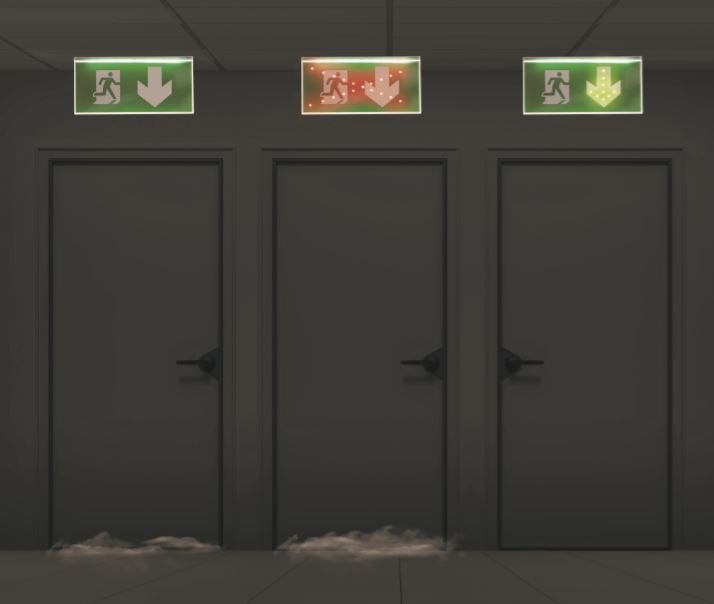
Are you looking for a higher level of safety from your passive fire protection system? Evaclite dynamic emergency exit signs have been proven to facilitate a safer evacuation during an emergency. The signs attract the eye and provide a dynamic pulsing array of light within the emergency luminaire, guiding you to a safe exit. Being intuitive the signs are easily understood by all languages.
Fire Safety in Tall Buildings: How can Evaclite help?
In London alone, there are 450 tall buildings in the pipeline. Of those, over 90 are being constructed, and the pace of tall building development in the capital is accelerating, with 28 tall building completions in 2017, and 40 more in 2018.
The rate and complexity of tall building construction are increasing and of course, with our population continuing to grow, cities will house many more people in tall buildings in the future. This being considered, our risk management systems need to align with this rapid growth and meet the growing demand. This is where dynamic and adaptive signage could be the answer for tall building safety regulations.
The Buildings Regulations 2010 set a list of minimum standards in respect of health and safety which must be abided by when constructing new buildings. These minimum standards include, for example, the requirement that a building must be, ‘designed and constructed so that there are appropriate provisions for the early warning of fire’ and ‘appropriate means of escape from a fire’. However, It is vital to note that the Building Regulations do not specify exactly how these standards should be met or what provisions should be put in place to meet the standards. This is often up to the construction team, among other contributors, such as fire engineers, to dictate how the standards will be met and what exact actions need to be taken to meet them.
This doesn’t always result in the highest standards of fire safety, as with lots of things, it’s on a scale and people have different opinions of what the standards are. This is where some people fall into the trap of doing the bare minimum when schedules and deadlines are tight, do we really look at the bigger picture? Do we consider what the best option would be, or simply look to tick a box.
Key issues in tall building evacuation: Currently, within the UK, there is no clear, authoritative definition of what constitutes a tall building or a high rise building, they tend to vary by local authority area. For example, in London, a tall building is defined as ‘those that are substantially taller than their surroundings, cause a significant change to the skyline or are larger than the threshold sizes set for the referral of planning applications to the Mayor (30m threshold).
However, in other areas of the UK, a tall building can be defined as any building over the height of 20m. However, contradicting this again, Approved Document B to the Building Regulations makes reference to a height of 18m.
If your organisation is located in a tall commercial building, the following issues regarding the safe evacuation of occupants in the event of a fire should be considered:
A standard, safe egress time as taller buildings will take longer to evacuate
The capacity of the escape routes to allow occupants to escape safely
The continued integrity of escape routes/building structure in a fire
The inability for the fire and rescue service to rescue occupants externally to the building above a certain height
Disabled guests, requiring assistance in an evacuation
How the responsibility is allocated to a person where there is shared occupancy of tall buildings (office blocks)
Risks involved with extended vertical evacuation down staircases (eg trips and falls).
How does Dynamic and Adaptive signage help?
It all comes down to two key factors, ‘increased affordance’ (you can see the sign clearly and quickly) and confidence (the dynamic pulsing green arrow emphasises the best route out).
Relying on our human instinct isn’t enough to get us out of danger, but with the use of dynamic signage, you see the signs quicker, you are given clear instructions and you can make your decision with 100% confidence. This speeds up the evacuation process and in a high rise building with multiple corridors and exits, this will reduce the bottlenecks. People will now disperse to the nearest exit, as guided by the signs, instead of returning to the first exit they can think of, inevitably being the way they came into the building.
Dynamic signs will give you a clear indication to the nearest exit, but if the nearest exit routes become compromised, because of either the initial or a developing hazard Evaclite signs become ‘adaptive’. They can adapt due to ‘cause and effect programming’ via the fire panel which identifies using sensors or human instruction that an exit route is now compromised and the emergency exit sign will change from green to red, indicating a negated exit route. Alternate safe exit routes will then be highlighted via the green dynamic flashing signs, preventing guests exiting towards the known hazard.
Here are a few examples of the benefits some Evaclite customers have shared with us:
Showing people the best routes to use during an evacuation makes people happier and more confident during a stressful time.
Improved affordance for emergency exit signs makes for a quicker evacuation.
Dynamic signs help reduce evacuation times with greater affordance for guests and a better reaction to false alarms.
People can be directed away from the fire and smoke ladened exits automatically and in real-time.
Reducing bottlenecks and congestion during an evacuation at door exits and in stairwells by showing people better more viable and quicker/easier routes away from the fire or out of the building.
Happier customers have confidence in staying in one of your hotels, in preference and hopefully more often.
Your hotel brand gets to show guests you really care about their experience, service excellence and their overall well-being.
Occupancy rates might increase with better reviews and greater confidence.
Reduce or avoid negative feedback and reviews.
So, it’s true, a passive sign does give you regulatory compliance, however when you are faced with a fire alarm activation and don’t know what move to make next, whether it’s a real fire or not, dynamic and adaptive signs come into their own.
Discover the full process of fire risk assessments in hotels and how they enhance guest safety — read our comprehensive guide.
Fire Risk Assessments in Hotels: The Complete Guide
Without question, the most important aspect of hotel fire safety is the safe evacuation of your guests. Guest safety should always be at the forefront of a hotel managers priorities and this should be consistent throughout all risk assessments and fire evacuation plans.
Hotel managers need to think much further ahead than simply the availability and protection of suitable fire escape routes because these are easy to assess. There are many variables to consider that you are often unable to strategically plan for. At the heart of a hotel’s priorities should be customer satisfaction and fire safety is another crucial way that we can meet the high standards of customer care that is expected from hotels.
Evacuation Issues to Consider
The evacuation of hotel guests certainly isn’t a simple process, it’s something that takes careful planning, but equally a fire is unpredictable, meaning you can’t always follow set rules.
In the event of a fire, evacuation is likely to involve large numbers of people in various areas of the hotel; dining rooms, bar, cafe areas, leisure facilities and bedrooms. When the hotel is at its busiest the sheer number of guests and people make the job of evacuation even tougher for staff. Its important staff are briefed for busy times and quiet times (for example at night – when a large percentage of fire alarms, false and real go off). Often staff numbers have to be increased to align with the growing number of occupants and they will all need to be briefed and thoroughly trained on the evacuation strategy.
An important part of a fire evacuation strategy is to ensure that all guests are given the knowledge to escape to a place of complete safety, easily and quickly, without the need for the fire service to intervene.
In the larger-scale hotels, it may be useful to also consider a phased evacuation, as it’s not always convenient for everyone to comply to the same set of rules, different floors will present a number of separate issues and challenges.
In the process of establishing the perfect arrangement for everyone, hotel managers will need to consider a variety of points, some of these are listed below:
High-Risk Guests
Guests with mobility restrictions: Disabled guests may be unable to move quickly or even move at all, because of this they may also not be able to use the staircases. As a rule, guests with high-risk mobility issues, such as those in wheelchairs should be booked into ground floor rooms, to avoid complications with stairs and also lifts (which should be out of use during a fire). If this isn’t possible, due to overcapacity, areas for safe refuge will need to be predetermined in the strategy, and these areas will need to be stocked ready with evacuation aids such as stretchers. In the event of a fire, the staff on duty will also be held responsible for keeping these customers safe.
Guests with hearing impairments: In the event of a fire, the first signal for guests is the fire alarm and this could cause significant issues for the guests who have hearing impairments. In this situation, the hotel staff need to identify the guests with hearing impairments and they can be issued with ‘under pillow buzzers’ that can either be triggered by the staff or the fire alarm itself.
Visiting Contractors: It is also important to consider other people who may be on-site, such as visiting contractors carrying out building work or people working events. The risk with these groups of people is that they’re unlikely to be as familiar with the building. It is essential that they also carry out a fire safety induction so that they are aware of the fire emergency arrangements.
Isolated Workers: Workers in isolated areas are at risk of missing fire alarm activations. Collecting the mobile numbers of these workers is an effective way of tracking this risk.
Potential obstacles in the evacuation process
Speed The most common milestone to overcome in the evacuation is speed. Guests are often extremely slow to evacuate their bedrooms. The cry wolf effect comes into play when they assume that it’s another false alarm or drill. Guests may open their doors and look around to check for other guests evacuating. Vocal alarm systems can help with this issue, this way staff can communicate with guests, confirming that there is a fire and advising them on the next steps.
Stubborn Guests
Sometimes guests can be stubborn when it comes to leaving the building, they may have just sat down for dinner or just bought a drink that they are now reluctant to leave behind in fear of losing their money. But, with the staff’s reassurance that their money will be reimbursed and their meals replaced, this should instil confidence in the guest.
No re-enter policy Large families and parties can be split up in the panic of an evacuation. Staff should ensure a policy where guests cannot re-enter the building to find loved ones and arrangements can be put in place for the care of unaccompanied children.
Alcohol-Impaired guests Another obstacle that many hotels don’t consider, is people who are impaired due to alcohol consumption. This can hinder people’s ability to rouse from their beds and severely hinder their reaction time to the sound of the fire alarm and the urgency of the evacuation.
Information for staff and guests
It is crucial that staff have extensive training in fire safety regulations and are armed with a clear set of actions to follow if a fire does occur. In addition to this, extra fire warden training will need to be provided for the key front of house staff who are most likely to be involved.
Guests must be provided with clear guidance of what to do in the event of a fire. Fire action notices in common areas and annotated floor plan drawings on the back of the bedroom doors comply with standards.
Throughout the night shifts, staff numbers are likely to be lower than normal. Considering this, there should be a list of phone numbers of key staff, such as the Hotel Manager who is ‘on-call’ in the event of a fire incident.
Wrapping up
When the next evacuation occurs, get your Hotel Management Team to evaluate the current evacuation process and identify any issues that occurred or aspects that didn’t run smoothly, to then relay this information back to the hotel staff.
Although a fire risk assessment may confirm that suitable and sufficient physical fire safety arrangements have been organised, hotel managers also need to implement a well thought through Fire Evacuation Plan to ensure that their hotel can be successfully evacuated.
Finish your coffee or get out? The science behind evacuation
Most of us have experienced a fire alarm, whether it’s a drill or the real thing.
But how do we react, and what can fire safety professionals learn from human behaviour during evacuations?
A recent study looked at forty unannounced building evacuations across nightclubs, cinemas and restaurants to see precisely what happens between realising something is wrong and making for the exit.
Deviating from normality
The study looked at two models:
The behavioural model: used to describe human behaviour during a real evacuation
The engineering model: relates to the behavioural model but considers elements such as movement problems and the way they impact subsequent behaviour
The main difference between the two models is how the response to evacuation is interpreted. In the behavioural model, a movement towards an exit is a response, whereas, in the engineering model, it’s treated as a separate phase of the evacuation process.
The key events of an evacuation are well-defined. For instance, the first stage of interest is when the occupants realise something is wrong. This ‘deviation from normality’ is triggered by the alarm itself, a strange smell or unusual noise.
The next important event is when the occupants link the unusual situation to a hazard. It’s at this point when people decide to do something which reduces the consequences for either themselves or other occupants.
The 4-stage reaction to fire
The human response to fire consists of four stages:
Receiving information. This relates to a cue, such as the sound of a fire alarm.
Interpret. The stage at which we link the sound (be it a siren or voice) to a hazardous event. This is where people will either ignore or investigate the cues.
Prepare. The reaction stage; acting on the given information, people will instruct others, investigate the cue or observe how others respond.
Act. The response to the cue. This might be an evacuation, warning others, waiting or fighting the fire.
Building evacuations rarely follow a prescribed sequence or set of procedures; it’s a far more dynamic process which depends on the type of building and its occupants.
In the event of a fire alarm, the pattern above may take place in a different order or even be repeated during the evacuation.
The human element
There are lots of factors that influence how people respond to fire alarms and the path they take through the four-stage process above.
For instance, the study revealed that social influence and group behaviour plays a vital role during the early stages of evacuation. This might be because people don’t want to act alone or are influenced by crowding, which can prevent them from acting before others have done so.
Evacuation decisions are also influenced by our desire to find friends and family before exiting. This relates to the theory of affiliation, where people tend to seek something familiar during an emergency.
This is something we can all relate to; we usually feel safer in a known environment. It’s why we’re more likely to leave in groups or choose a known evacuation route such as the office entrance, even if an emergency exit is closer.
The study also discusses the role-rule model, where the way in which people react to emergencies is affected by an implied set of rules relating to their role. For instance, staff and customers in a shopping centre will probably have different reactions to an evacuation.
Which alarms are the most effective?
There are many different types of fire alarm on the market, but which is most effective?
Studies have revealed that voice alarms are the most effective for public buildings, but note that previous knowledge of the meaning and existence of an alarm will impact the evacuation response.
This might be why a simple alarm bell initiates an evacuation in an office environment faster than a shopping centre; office workers are more likely to be aware of the alarm sound and its meaning.
“But, I haven’t finished my coffee…”
Video recordings formed part of the research and revealed that in some instances, people would go back and forth between the recognition of a fire alarm and their response.
Restaurants and cafes demonstrated particularly long response times, not least because people seemed unwilling to leave the food or drink for which they’d paid.
It was a similar story in university lecture rooms where students would continue working before showing any recognition of the fire alarm. Likewise, office workers appeared to ignore the alarm initially to finish the task on which they were working.
Social influence plays a significant role in the recognition and response time. People observe others, and if their reactions don’t match what is believed to be the ‘right’ response to an alarm, they’ll react in the same way.
This was evident in the university and cinema experiments where occupants began evacuating only to stop and return to their seats when they realised others hadn’t moved.
The report is fascinating, but it’s clear that human behaviour during a fire rarely follows a predefined pattern – even if studies show there are common behavioural sequences.
It’s hoped that the information provided in the paper will be used to help fire safety professionals accurately predict the time required to evacuate different premises.
Going beyond the Minimum – Fire Safety Standards
Evaclite outlines current thinking within the industry and how specifiers have new innovations in their toolbox that can ensure compliance…and beyond.
It is possible to design a building to comply with the standard codes of practice, as set out in Approved Document B (ADB) of the Building Regulations and the Regulatory Reform (Fire Safety) Order 2005 (or RRO)
But while the regulations provide a minimum standard of fire safety, for many building owners it is not simply about complying with the regulations.
Approved Document B has recently been updated to restrict the use of desktop studies or assessments in lieu of testing. This approach has been commonly used and is where previous test data is used to suggest how a system or materials will perform in the event of a fire. However, in reality, it is often impossible to accurately predict how it will react in practice as even small changes to the design or build up can significantly affect its fire performance. Similarly, what other systems and procedures that are accepted as the norm should we now be looking at?
Historical events have highlighted the need to not only ensure compliance with the regulations but have also opened up discussions on whether compliance with the minimum provides a solution for all?
An example of this is The King’s Cross Underground Fire on November 18th,1987. Most of the people that died, did so because they took the wrong route out of the station, they took an evacuation route that leads them into the path of the fire. Thirty two years on and now in the 21st century, with new technologies in adaptable, intelligent emergency exit signage, is it still acceptable for instance to be using dumb “standard” exit signs that can potentially lead people towards a hazard?
Is it even possible today to design a building that’s fireproof? Probably not 100%, and if it does burn it’s going to produce smoke, heat and toxic gases. Fire design engineering is also about making sure we can get people out of that structure as quickly and efficiently as possible, eliminating bottlenecks and directing people to the safest exits and avoiding smoke-filled corridors, as set out in BS5266-1 :2016 Annex B. Integration of building systems such as fire detection and emergency lighting can enable quicker, safer and more decisive evacuation.
Fire safety engineering is not just about compliance with a set of prescriptive codes, it is about developing performance-based solutions that are not only safer but can be cost effective without having to implement complicated systems or change the original design and thus satisfying the architect’s aspirations.
While the regulations provide a minimum standard of fire safety, the events of recent years have demonstrated the importance of going beyond the minimum to optimise the safety of building occupants.
Want to discover why hotels are making the move to dynamic and adaptive signage?
Download our free eBook: ‘Dynamic Emergency Exit Signage: Why the time is now for the hotel sector’ to discover the wider problems facing hotels and how they deal with some very practical customer experience issues.